More social media use linked to poorer sleep and self-rated health among college students
Mason: Health Starts Here study finds that sleep may help explain the relationship between social media use and
Press Release Disclaimer: This is a press release distributed through the XPR Media network. It has not been independently verified by our newsroom.

Mason: Health Starts Here study finds that sleep may help explain the relationship between social media use and students’ perceived health
FAIRFAX, VA, UNITED STATES, September 21, 2026 /EINPresswire.com/ — College students who spend more time on social media tend to sleep worse, and that may have consequences for how they perceive their own health, according to a new George Mason University’s College of Public Health study.
The study, published in Public Health Reports, found that greater social media use at the start of the school year predicted poorer sleep quality six months later, which in turn predicted worse self-rated health six months after that. According to the researchers, it’s the first study to indicate that poor sleep quality may be a pathway connecting social media use with self-rated health.
“These findings suggest that students’ social media habits early may have effects beyond the time spent on the phone,” said study lead author Akosua Mainoo, alumna of the Department of Global and Community Health. “Sleep appears to be one way those habits may carry over into how students perceive their health months later.”
One finding ran counter to the researchers’ expectations: Greater overall social media use was associated with poorer sleep, but nighttime use specifically was not. Researchers noted that previous studies on nighttime social media use and sleep have been mixed, and that the effects may depend on other factors, such as light exposure affecting melatonin levels.
The research is part of Mason: Health Starts Here, the university’s landmark cohort study following students across their four undergraduate years. Lawrence Cheskin, distinguished professor in the Department of Nutrition and Food Studies, serves as principal investigator.
Why it matters
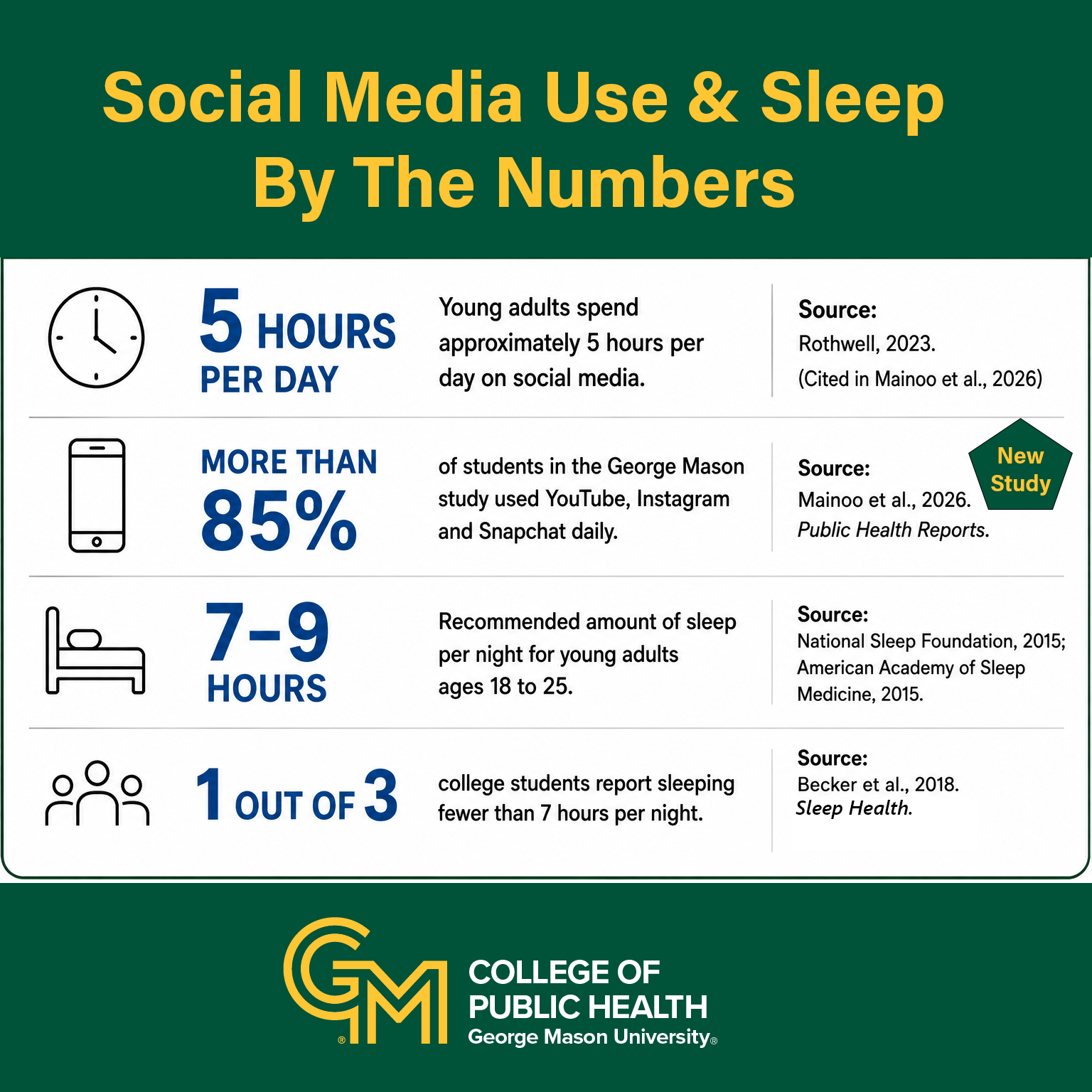
Young adults spend about five hours a day on social media, and more than 85% of students in the George Mason study used YouTube, Instagram and Snapchat daily. Although seven to nine hours of sleep is recommended for young adults, previous research has found that one-third of college students get fewer than seven. Over time, not getting enough sleep is linked to health problems, including depression, obesity, heart disease, and diabetes.
The new study goes a step further in examining how sleep may connect social media use with students’ broader health over time.
Asked in an interview what students should take from the findings, the researchers pointed to the value of reducing social media use.
“Social media is a part of everyday life for college students, so the expectation isn’t to eliminate it,” said Mainoo (MPH ’22 in Epidemiology, BS ’20 in Community Health). “But young people can be more intentional about setting time limits and creating phone-free zones.”
Cheskin said “less is more when it comes to social media use by young college students,” and that reducing use can leave more time for “direct interactions with peers and others.”
More study information
The researchers analyzed data from 349 first-year students ages 18 to 24 participating in Mason: Health Starts Here, the broader longitudinal study examining predictors of physical and mental health throughout college. Students completed surveys in August 2019, February 2020, and August 2020.
The researchers noted limitations including self-reported data and participant drop-off over time, and called for more longitudinal research on how social media use may affect sleep and health.
The research team also included Lilian de Jonge and Fritz Nii Tettey Lokko of the Department of Nutrition and Food Studies; and Jerome L. Short, Eleanor A. Speidel, Jeremy Maciarz, Patricia J. Mejia, and Emmarose Logan Price of the Department of Psychology. The study was funded by the George Mason Institute for Biohealth Innovation.
About George Mason University
George Mason University is Virginia’s largest public research university. Located near Washington, D.C., Mason enrolls more than 40,000 students from 130 countries and all 50 states. Mason has grown rapidly over the past half-century and is recognized for its innovation and entrepreneurship, remarkable diversity, and commitment to accessibility. In 2023, the university launched Mason Now: Power the Possible, a one-billion-dollar comprehensive campaign to support student success, research, innovation, community, and stewardship. Learn more at gmu.edu.
About College of Public Health at George Mason University
The College of Public Health at George Mason University is the first College of Public Health in Virginia and a national leader in inclusive, interprofessional, public health research, education, and practice. The college comprises public health disciplines, health administration and policy, informatics, nursing, nutrition, and social work. The college offers a distinct array of degrees to support research and training of professionals dedicated to ensuring health and well-being for all. The college’s transdisciplinary research seeks to understand the many factors that influence the public’s health and well-being throughout the lifespan.
Mary Cunningham
George Mason University College of Public Health
+ +1 703-993-1931
email us here
Visit us on social media:
LinkedIn
Instagram
Facebook
YouTube
Legal Disclaimer:
EIN Presswire provides this news content “as is” without warranty of any kind. We do not accept any responsibility or liability
for the accuracy, content, images, videos, licenses, completeness, legality, or reliability of the information contained in this
article. If you have any complaints or copyright issues related to this article, kindly contact the author above.

Media gallery